Back To Business

Teaching fills up available time so this blog sits abandoned while the school blog and Schoology fill with details of education. Someone, I suppose with some effort I could find out who, said once, “Work fills up available time.” Then there is the expectation of reflection on process, product, and result should one have a moment to look out across the field into the copse.

Lao-tzu wrote, “Work is done and then forgotten.” In such a world, work suits life, keeps it going, ensures that what is needed, gets done. Our world makes all of us strivers. It is exciting and wonderful in a way that makes all of creators. And yet living for what may be rather than now tosses away the past and erodes the present. What will our children and grandchildren look back to, past hopes for the future?

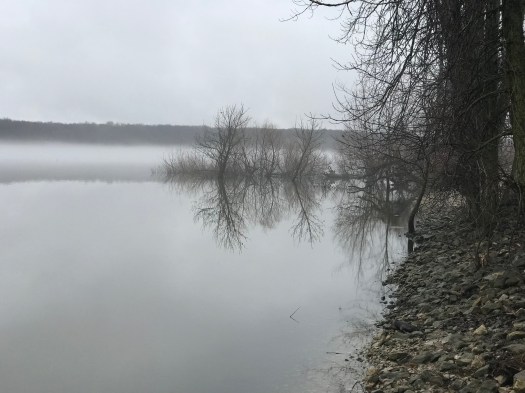
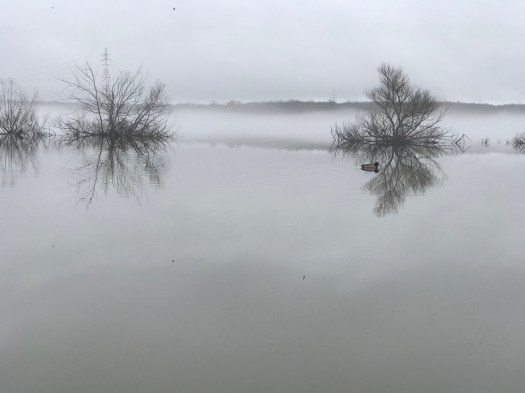
Foggy Morning

Foggy morning at Hoover Reservoir this past week.  I was driving by and stopped.  Five minutes later the fog had drifted off and the rains came.

IMG_6050IMG_6049IMG_6045IMG_6017

Klappstühle

Yesterday, I ran across Klappstühle a poem by Günther Grass. It reads,

Wie traurig sind diese Veräderungen
Die Leute schrauben ihre Namensschilder ab,
nehmen den Topf mir dem Rotkohl,
wärmen ihn auf, anderen Ortes.
Was sind das für Möbel,
die fürden Aufbruch werben,
Die Leute nehmen ihre Klappstühle
und wandern aus.
Mit Heimweh und Brechreitz beladene Schiffe
tragen patentierte Sitygelegenheiten
und patentlose Besitzer
hin und her.
Aud beiden seiten des grossen Wassers
stehen nun Klappstühleö
wie traurig sind diese Veränderungen.

While looking up the date of publication, I ran across a musical rendition by Ronald Perara who set Three Poems By Günther Grass to music in 1974. Klappstühle is the second on his Crossing the Meridian Album. You can hear it at Klappstühle and read about its setting with two other poems  at Three Poems of Günther Grass

The music does not touch me deeply, certainly, not as deeply as the poem. Folding chairs as a metaphor of the emigrant experience works quite well. The musical piece is pre-Glass classical. I find I recoil from it now, although then we struggled to understand what the composer was adding to the piece. But Perara is not Britten setting Owens poems to music sensitively. Would it be too harsh to say the music would not be to different were it reporing the grocery list? Yes, it is, but so it strikes me now. Our wilingness – my willingness – to struggle while listening to music changed with Einstein At The Beach.

Easter

Thinking about poems off and on during Easter visits and basketball games. Housman, of course, with the trees ‘wearing white for eastertide’ and Brecht’s Frühling 1938 where he and his son protect the apricot tree with the 3rd Reich in the background. And Easter 1916 wherein Yeats’ wrote:

I have met them at close of day
Coming with vivid faces
From counter or desk among grey
Eighteenth-century houses.
I have passed with a nod of the head
Or polite meaningless words,
Or have lingered awhile and said
Polite meaningless words,
And thought before I had done
Of a mocking tale or a gibe
To please a companion
Around the fire at the club,
Being certain that they and I
But lived where motley is worn:
All changed, changed utterly:
A terrible beauty is born.

but, today, I recall the poem Edward Thomas wrote – Memoriam, Easter 1915

The flowers left thick at nightfall in the wood
This Eastertide call into mind the men,
Now far from home, who, with their sweethearts, should
Have gathered them and will do never again.

And, if I remember correctly, Thomas died in a shell blast, or perhaps by a gunshot, on Easter Monday 1916 at the battle of Arras. He ws widely memorialized, Frost wrote in the poem, For E.T.

I slumbered with your poems on my breast
Spread open as I dropped them half-read through
Like dove wings on a figure on a tomb
To see, if in a dream they brought of you,

I might not have the chance I missed in life
Through some delay, and call you to your face
First soldier, and then poet, and then both,
Who died a soldier-poet of your race.

I meant, you meant, that nothing should remain
Unsaid between us, brother, and this remained—
And one thing more that was not then to say:
The Victory for what it lost and gained.

You went to meet the shell’s embrace of fire
On Vimy Ridge; and when you fell that day
The war seemed over more for you than me,
But now for me than you—the other way.

How over, though, for even me who knew
The foe thrust back unsafe beyond the Rhine,
If I was not to speak of it to you
And see you pleased once more with words of mine?

Stafford

William Stafford’s poetry came to my attention at a time when I was reading and translating Brecht, Hermlin and other DDR (East Germany) poets and novelists. The unassuming, but not simple, thoughts of poems to be read softly appealed to me as I read the 1983 edition of Smoke’s Way: Poems fom Limitd Editions 1968 -1981.

Here are three of them.

West of Here

The road goes down. It stops at the sea.
The sea goes on. It stops at the sky.
The sky goes on.

At the end of the road – picnickers,
rocks. We stand and look out:

Another sky where this one ends?
And another sea?
And a world, and a road?

And what about you?
And what about me?

At An Interval We Talk

An owl call – round, globed as the moon –
floats from the night though the open window
and brushes my face with the whole world
outside our home.

The woods flow back. The years I’ve had
have floated away. Without a sound
I turn my face and its hunger for the world,
here: today.

Smoke

Smoke’s way’s a good way – find,
or be rebuffed and gone:
a day and a day, the whole world home.

Smoke? Into the mountains I guess
a long time ago. Once here, yes,
everywhere. Say anything? No.

I saw Smoke, slow traveler, reluctant
but sure. Hesitant sometimes, yes,
because that’s the way things are.

Smoke never doubts though:
some new move will appear.
Wherever you are, there is another door.

Sassoon

In the late February sunlight this morning, I sat in the chill, drinking coffee, thinking of Siegfried Sassoon. We have just passed the 100th commemoration of the battle of Verdun. A century ago on July 1, 1916, the British Army walked into the machine guns at the Somme. In Memoirs of a Fox Hunting Man and the following two volumes of the trilogy, Sassoon lets us see the collapse of the old order and the impact of the trenches on men. There are other writers deeper, wiser, sadder – I have spent decades reading poetry, novels, primary and secondary sources. Still Sassoon gives us a picture of what the historians call, “a paradign shift” on an innocent man caught up in a Great War that killed millions as it drove a world into modernity.

In an ironically bitter poem, Sassoon wrote:

Does it matter? -losing your legs?
For people will always be kind,
And you need not show that you mind
When others come in after hunting
To gobble their muffins and eggs.
Does it matter? -losing you sight?
There’s such splendid work for the blind;
And people will always be kind,
As you sit on the terrace remembering
And turning your face to the light.
Do they matter-those dreams in the pit?
You can drink and forget and be glad,
And people won’t say that you’re mad;
For they know that you’ve fought for your country,
And no one will worry a bit.

Sassoon like Owen, Thomas and the other battlefield poets earned his bitterness, his right to speak of the wounded and dead, the trenches and the home front and wrote beautifully and movingly of what was ugly and unthinkable. He often wrote of the beauties of nature noticed in between or during the battles. How long ago all this seems and how contemporary, too.

Gustaffson

It’s hard to speak of things that move us – a poem, a song, a painting. Harder still to speak of the accomplishments of an artist from whose works we learned there is a greatness that seems timeless and that lifts us. “I really like this”. “Listen!” are inadequate. The intellectual explanations painful. Still, we try. The Swedish poet Lars Gustafsson felt  – as do I about Bach – therre was music before him but nothing like him not even in the great contrapuntalists. He wrote,


The Stillness of the World Before Bach


There must have been a world before
the Trio Sonata in D, a world before the A minor Partita,
but what kind of a world?
A Europe of vast empty spaces, unresounding,
everywhere unawakened instuments
where the Musical  Offering, the Well-tempered Clavier
never passed across the keys.
Isolated churches
where the soprano line of the Passion
never in hopeless love twined around
the gentler movements of the flute,
broad soft landscapes
wherre nothing breaks the stillness
but old woodcutters’ axes,
the healthy barking of strong dogs in winter
and, like a bell,skates biting into fresh ice;
the swallows whirring through summer air,
the shell sounding at the child’s ear
and nowhere Bach nowhere Bach
the world in a skater’s stillness before Bach.
                              (translated: Philip Martin in The Stillness of the World Before Bach: New Selected Poems, 1982)

Thoughts on Rexroth

Immediately preceeding two deep, reflective eulogies – one for his mother Delia the other for his wife Andree, Kenneth Rexroth placed the poem, “It Rolls On” when he published The Phoenix and the Tortoise. (1944).

The opening line reminds me of a Basho haiku, (Falling ill on a journey, my mind runs round a withered field), the second line of Yeats, The Wild Swans at Coole. The poem’s tone and sense of wearing travel and fatiguing restlessness contrasts so tightly with the warblers in their lives.

Time passes. Who else documents it as well as Rexroth? Read his work from the 1940s and 1950s as he looks backward with an awareness that informs a lifetime. Andree Rexroth  Delia Rexroth

IT ROLLS ON

Irresolute, pausing on a doubtful journey;
Once more, after so long, the unique autumnal
Wonder of the upper Hudson about me;
I walk in the long forgotten
Familiar garden. The house was never
Reoccupied, the windows are broken,
The walls and the arbors ruinous,
The flower beds are thickets,
The hedges are shattered,
The quince and hawthorns broken and dying.
One by one the memory of twenty years
Vanish and there is no trace of them.
I have been restless in many places
Since I rested in this place.
The dry thickets are full of migrating
Green-grey warblers. Since last fall
They have visted Guatemala and Labradour
And now they are bound south again.
Their remote ancestors were doing the same thing
When I was here before. Each generation
Has stopped for an autumn evening
Here, in this place, each year.
          Kenneth Rexroth (The Complete Poems of Kenneth Rexroth, page 218)