For The Union Dead

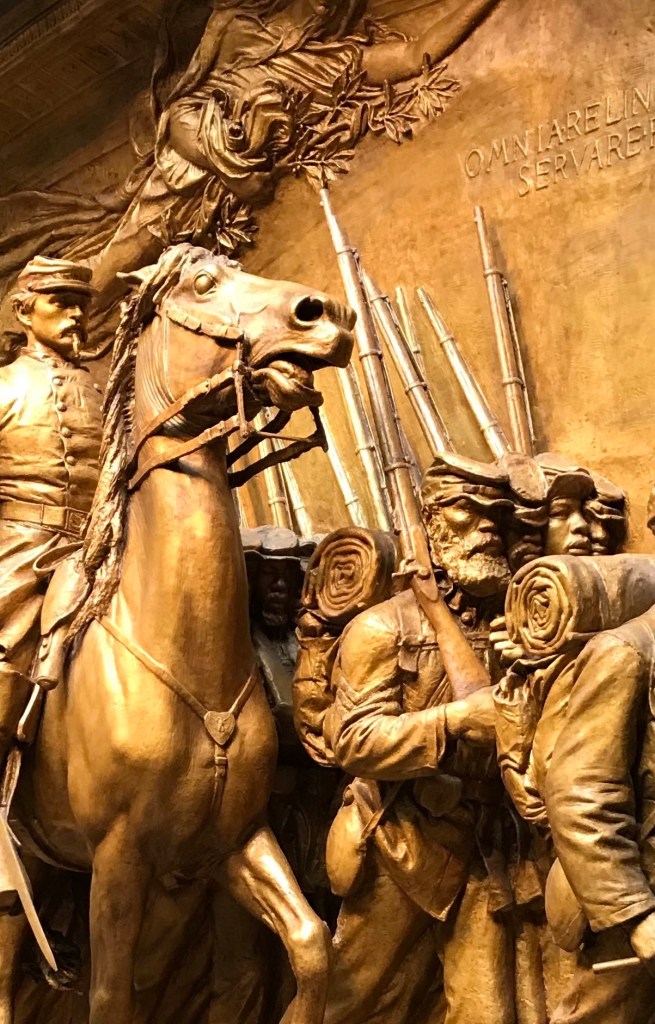
A National Gallery of Art plaster version of St Gaudens’ Civil War Relief of the 54th Massachusetts Regiment

When I first read Lowell’s For The Union Dead (Published 1964), I lived on Kadettenweg in Berlin in the early 1970s, I was struck by how he managed the historical in the moment, but thought he lost the vividness of the television image. I had been reading Life Studies carefully and critically, but found in For The Union Dead a depth that I don’t think Lowell – or perhaps any of the ’60s poets – matched. I know that many like the The Quaker Graveyard in Nantucket, but I never quite found a way into that poem –

“Relinquunt Omnia Servare Rem Publicam.”

The old South Boston Aquarium stands
in a Sahara of snow now. Its broken windows are boarded.
The bronze weathervane cod has lost half its scales.
The airy tanks are dry.

Once my nose crawled like a snail on the glass;
my hand tingled
to burst the bubbles
drifting from the noses of the cowed, compliant fish.

My hand draws back. I often sigh still
for the dark downward and vegetating kingdom
of the fish and reptile. One morning last March,
I pressed against the new barbed and galvanized

fence on the Boston Common. Behind their cage,
yellow dinosaur steamshovels were grunting
as they cropped up tons of mush and grass
to gouge their underworld garage.

Parking spaces luxuriate like civic
sandpiles in the heart of Boston.
A girdle of orange, Puritan-pumpkin colored girders
braces the tingling Statehouse,

shaking over the excavations, as it faces Colonel Shaw
and his bell-cheeked Negro infantry
on St. Gaudens' shaking Civil War relief,
propped by a plank splint against the garage's earthquake.

Two months after marching through Boston,
half the regiment was dead;
at the dedication,
William James could almost hear the bronze Negroes breathe.

Their monument sticks like a fishbone
in the city's throat.
Its Colonel is as lean
as a compass-needle.

He has an angry wrenlike vigilance,
a greyhound's gentle tautness;
he seems to wince at pleasure,
and suffocate for privacy.

He is out of bounds now. He rejoices in man's lovely,
peculiar power to choose life and die--
when he leads his black soldiers to death,
he cannot bend his back.

On a thousand small town New England greens,
the old white churches hold their air
of sparse, sincere rebellion; frayed flags
quilt the graveyards of the Grand Army of the Republic.

The stone statues of the abstract Union Soldier
grow slimmer and younger each year--
wasp-waisted, they doze over muskets
and muse through their sideburns . . .

Shaw's father wanted no monument
except the ditch,
where his son's body was thrown
and lost with his "niggers."

The ditch is nearer.
There are no statues for the last war here;
on Boylston Street, a commercial photograph
shows Hiroshima boiling

over a Mosler Safe, the "Rock of Ages"
that survived the blast. Space is nearer.
When I crouch to my television set,
the drained faces of Negro school-children rise like balloons.

Colonel Shaw
is riding on his bubble,
he waits
for the blessèd break.

The Aquarium is gone. Everywhere,
giant finned cars nose forward like fish;
a savage servility
slides by on grease.


The Wanderer

The late Polish poet Adam Zagajewski whose work rests on the foundation of exceptional Polish poets of the twentieth century, but whom I find more approachable, in that I can sense my own life in his works, published —

The Wanderer

I enter the waiting room of a station.

Not a breath of air.

I have a book in my pocket,

someone’s poems, traces of inspiration.

At the entrance, on benches, two tramps and a drunkard

(or two drunkards and a tramp).

At the other end, an elderly couple, very elegant, sit

staring somewhere above them, toward Italy and the sky.

We have always been divided. Mankind, nations,

waiting rooms.

I stop for a moment,

uncertain which suffering I should

join.

Finally, I take a seat in between

and start reading. I am alone but not lonely.

A wanderer who doesn’t wander.

The revelation

flickers and dies. Mountains of breath, close

valleys. The dividing goes on

Clarity

When I caught the flu over New Year, I felt such clarity while I had a temperature – in bed with nothing to think about, watch, listen to, I discovered exactly what needed to be written for two specific stories. Healed, mended I cannot quite remember what was so clear, so certain.

The feeling was an explosion of the feeling I have, that others describe when suddenly an idea is in your mind fully realized, or so it seems. But then you have to sit down and do the hard work of making it tangible. The duty of creativity.

Late Night Tea

Up in the night reading Su Tung-p’o in Burton Watson’ translation I was struck how it is the details that hold the fast moving year in check as much as it is possible to do so. I went to bed as the 3am train rolled on the tracks miles away in Worthington.

Dipping Water from the River and Simmering the Tea

Living water needs living living fire to boil;

lean over Fishing Rock, dip the clean clear current;

store the spring moon in a big gourd, return it to the jar;

divide the night sky with the little dipper, drain it into the kettle.

Frothy water, simmering, whirls bits of tea

pour it and hear the sound of wind in the pines.

Hard to refuse three cups to a dried-up belly;

I sit and listen — from the old village clock, the striking of the hour.

Veterans’ Day

Thinking this morning of soldiers I have known in my life, particularly of two young men with whom I went through basic training – they did not return from Vietnam.

As Binyon wrote in September 1914 looking out on to the Atlantic –

“They shall grow not old, as we that are left grow old:
Age shall not weary them, nor the years condemn.
At the going down of the sun and in the morning
We will remember them.”

—- — —

In the 20th century, I can name fourteen close family members who served in the US military – all but one of whom returned alive, some with the troubles war impresses upon a man or woman.

Those who chose or were chosen to serve, did so to honor a sense of what a person owes as a citizen, It is the responsibility of the government to ensure those wars are just and worthy – everything is changed by war and where one is fought there is chaos, dread and destruction both immediate and for decades thereafter. And it is the responsibility of a democratic people to elect a government aware of such a responsibility.

Note : I feel as I read of the turbulence of these times as if my thoughts arose from one of the characters in a long work I am writing. Set in 1919.

Brushes

The Tombow Fudenosuke brushes are just suited for me to write Chinese characters. I haven’t tried them with Japanese yet but I’m sure they will be so much better than what I have been using. I have no gift for 草书 and am satisfied to produce easily read 楷书.

The right tool makes learning and production so much easier.

老夫